
Reggie and Hepatitis C
During the years when Reggie’s heroin addiction was becoming increasingly serious, he was diagnosed with hepatitis C.
For our family, hepatitis C was another consequence of his addiction that we knew relatively little about at the time. Reggie believed he knew when he had been exposed to the virus, although there is no way for us to know with certainty that this particular incident was the source of his infection.
The Days of Wine and Beer Store
During this period, it was not uncommon to come into the Days of Wine and Beer store and find Reggie completely stoned.
Despite that, the store was a success. Reggie had identified a hole in the market. People were interested in brewing their own beer and wine, and the business filled a need. He was also fortunate to have his sister-in-law helping to run the store.
It was one of the contradictions that appeared repeatedly in Reggie’s life: parts of his life could appear to be working even as his addiction was becoming increasingly destructive.
It was during this period that Reggie believed something happened that would have lasting consequences for his health.
How Reggie Believed He Contracted Hepatitis C
Editor’s Note: Reggie had always said that he would never share a needle. He understood the risks and apparently regarded that as a line he would not cross.
Reggie later told us that while intoxicated on heroin, he shared injection equipment with a friend who he subsequently learned had hepatitis C. He believed it was the first time he had done so.
Reggie was later diagnosed with hepatitis C and believed this was when he had been infected. Without medical evidence tracing the infection to a particular exposure, however, we cannot know that with certainty.
What is striking is that Reggie understood the danger and had made a rule for himself that he would never share a needle. But while intoxicated, a rule that had once seemed absolute disappeared.
It was another example of the difference between understanding the risks of addiction and being able to control your behaviour while in its grip.
Hepatitis C and the Risk of Sharing Injection Equipment
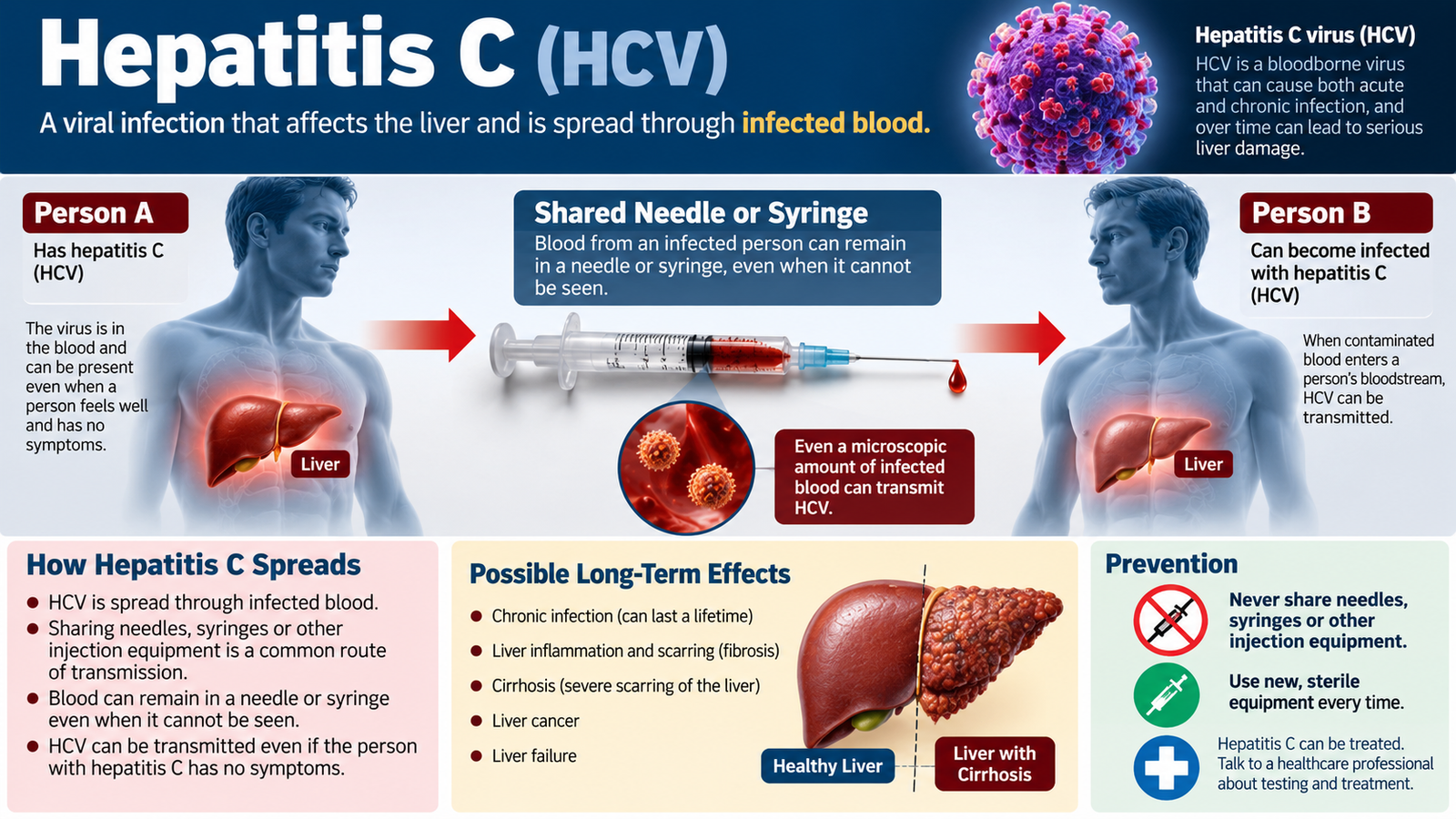
Hepatitis C is a viral infection of the liver transmitted through infected blood. Sharing needles, syringes or other equipment used to inject drugs is an important route of transmission.
Even when blood cannot be seen, contaminated equipment can potentially carry the virus. A single exposure can be enough to transmit hepatitis C.
Many people have no symptoms for years. For some, the infection becomes chronic and can eventually cause serious liver damage.
Treatment has changed dramatically since Reggie’s time. Today, hepatitis C can usually be cured with antiviral medication.
Was Reggie Contagious to His Family?
This is something families understandably worry about, but hepatitis C is not spread through ordinary household contact.
Living with Reggie, visiting him, hugging him or eating with him did not put us at risk. The concern was contact with infected blood.
Personal items that could have blood on them, such as razors, toothbrushes and nail clippers, should not be shared. Cuts and open wounds should also be covered.
Sexual transmission can occur, although the risk is generally much lower than with direct blood exposure such as sharing injection equipment.
So although hepatitis C is a serious infectious disease, Reggie was not a danger to the people around him simply because they were around him.
The Effect on Reggie
Reggie rarely complained to us about the effect hepatitis C was having on his health, but from the outside I thought I could see a physical change.
He often looked tired and seemed to have very little energy.
I cannot know how much of that was caused specifically by hepatitis C. Addiction, withdrawal, medications, stress and everything else happening in Reggie’s life could also have contributed.
When I look back at this period, what strikes me is everything he was dealing with at once.
He was fighting heroin addiction.
He was living with hepatitis C.
He had a criminal record.
And when he tried to rebuild his life, he faced the additional pressure of finding meaningful employment while that record closed doors in front of him.
It is easy, looking from the outside, to say what someone should have done.
I don’t know what I would have done in his position.