
Mapping the Recovery
When the first bone was found, our family was puzzled. If these were Reggie’s remains, why had only a single bone been discovered? Why wasn’t the rest of his body nearby?
My brother and father began to wonder whether coyotes might explain what was happening. They soon spoke with a local person knowledgeable about coyotes, trying to understand how animals might disturb and move remains and how far individual remains might be carried. At the time, this was more than curiosity. They hoped that anything they could learn might provide useful information to those continuing to search the woods.
As the search progressed, additional remains and pieces of Reggie’s clothing were discovered at different locations. The RCMP search map below shows just how widely separated some of those discoveries were.
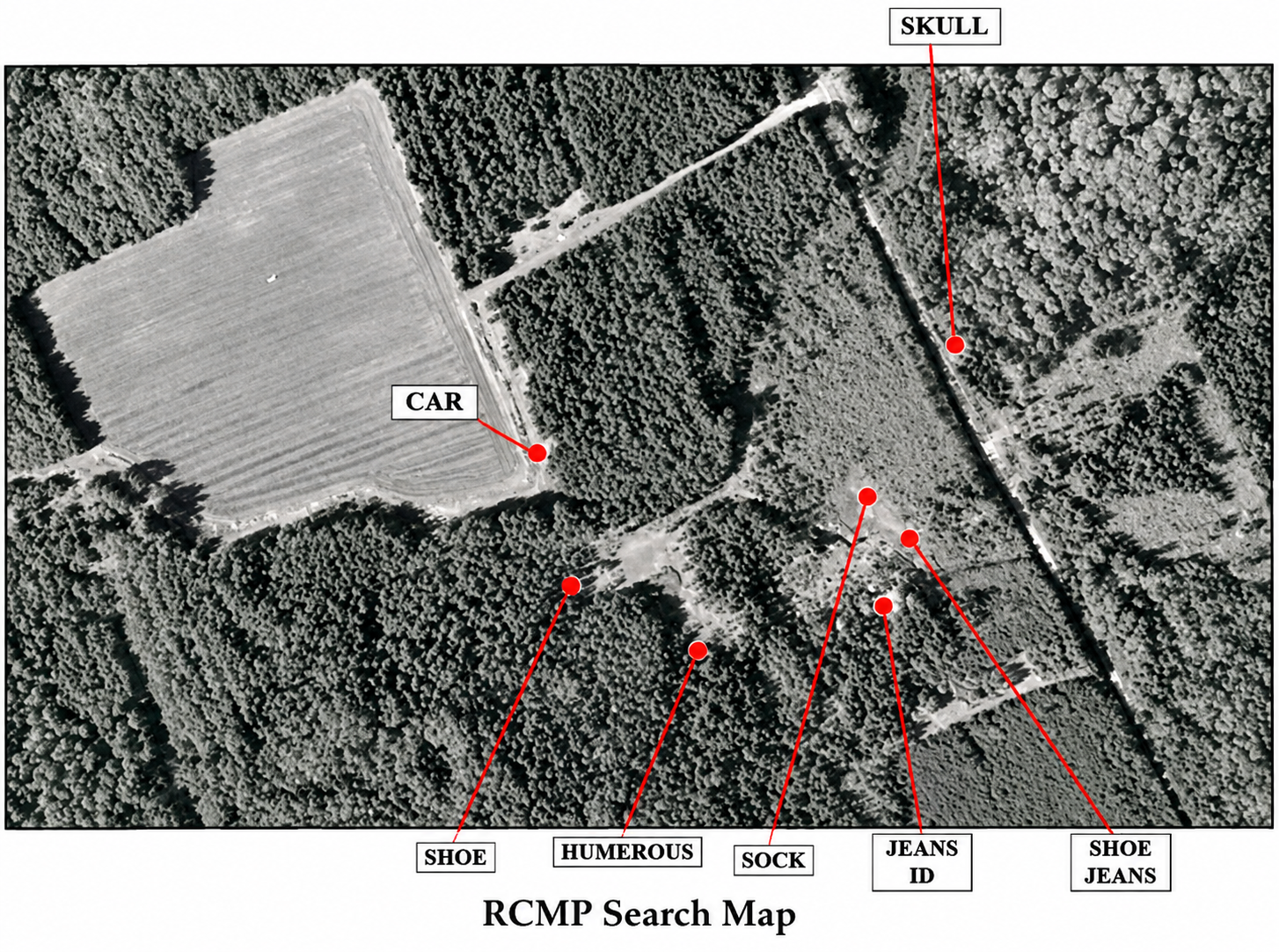
The map helped us understand something that had been difficult to comprehend when that first bone was found. Reggie’s remains had not remained together in one location. They had been dispersed through the surrounding woods, along with clothing and other personal effects.
The Skull
The location of Reggie’s skull raised another question for us. The people we consulted about coyotes told us that a skull could be carried away from the rest of the remains and that coyotes might push or roll it around.
A couple of years later, we got a Chesapeake Bay Retriever. He would sometimes take a ball and roll it with his nose, going back and forth up the driveway while growling at it for minutes at a time.
It disturbed me to watch him do it. Every time he did, I thought of my brother.
The RCMP Perspective
Years later, when I interviewed RCMP officer Marc Potvin, I asked him whether police had originally expected to find an intact body.
His answer gave me a very different perspective on the search.
Marc explained that when someone has died and remained exposed in the woods for an extended period, investigators have to consider from the beginning that wildlife may have disturbed and scattered the remains. What had initially surprised and confused our family was therefore a possibility the RCMP was prepared to encounter.
Marc also helped me understand why police are cautious about allowing family members and members of the community to participate in this kind of recovery search.
He explained that there are practical investigative reasons for controlling access to a search area, including protecting possible evidence and avoiding contamination. But there is also a human consideration. Searchers looking for remains may encounter extremely disturbing scenes. Police have to consider the possibility that a family member could discover something involving their loved one that they would then have to carry with them for the rest of their life.
Editor’s note: The preceding paragraph summarizes what Marc explained to me during our interview. It is not intended as a direct quotation.