
Cannabis
Cannabis appears throughout Reggie’s writings and played a role in his life from a remarkably young age. Before exploring that part of his story, it is helpful to understand what cannabis is, the different forms it can take, how it was commonly used, and the effects it can have.
On This Page
Part 1 — Understanding Cannabis · Part 2 — Cannabis in Reggie’s Life · Part 3 — Selected Stories & Writings
Part 1 — Understanding Cannabis
Cannabis is a plant containing chemical compounds called cannabinoids. Two of the best known are THC (tetrahydrocannabinol) and CBD (cannabidiol).
THC is primarily responsible for the intoxicating effect commonly described as being “high.” CBD does not produce the same intoxicating effect, although it can still affect the brain and body.
The word cannabis is sometimes used interchangeably with marijuana, but they do not mean exactly the same thing. Cannabis is the broader term. Marijuana, hashish and hash oil are different products derived from cannabis.
A Note About the Cannabis Products Covered Here
This section focuses primarily on the forms of cannabis that appear in Reggie’s writings: marijuana, hashish and hash oil.
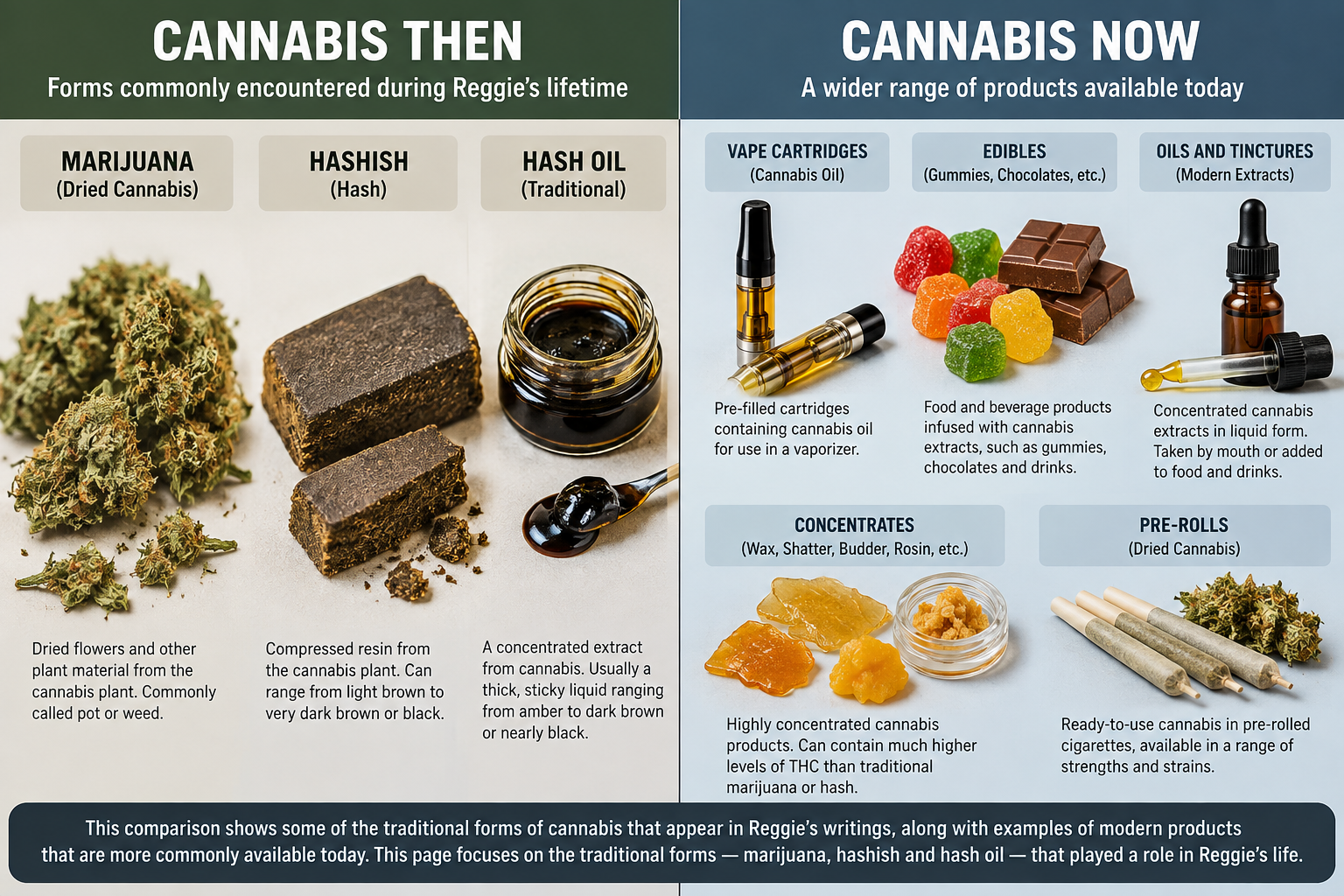
Cannabis products have changed considerably since Reggie’s lifetime. Today’s market also includes vape liquids and cartridges, gummies and other edibles, oils and tinctures, and concentrated products such as resin, rosin, wax, shatter and budder. Some can contain much higher concentrations of THC than traditional dried marijuana.
These newer products are mentioned only where they provide useful context. The focus of this page remains on the cannabis products relevant to Reggie’s own story.
Marijuana
Marijuana—also commonly called pot or weed—generally refers to the dried flowers and other plant material of the cannabis plant.
It can vary considerably in appearance, but dried marijuana typically consists of green, brown or grey-green pieces of dried plant material. Depending on the product, leaves, stems, seeds and dried flower buds may be visible.
Hashish
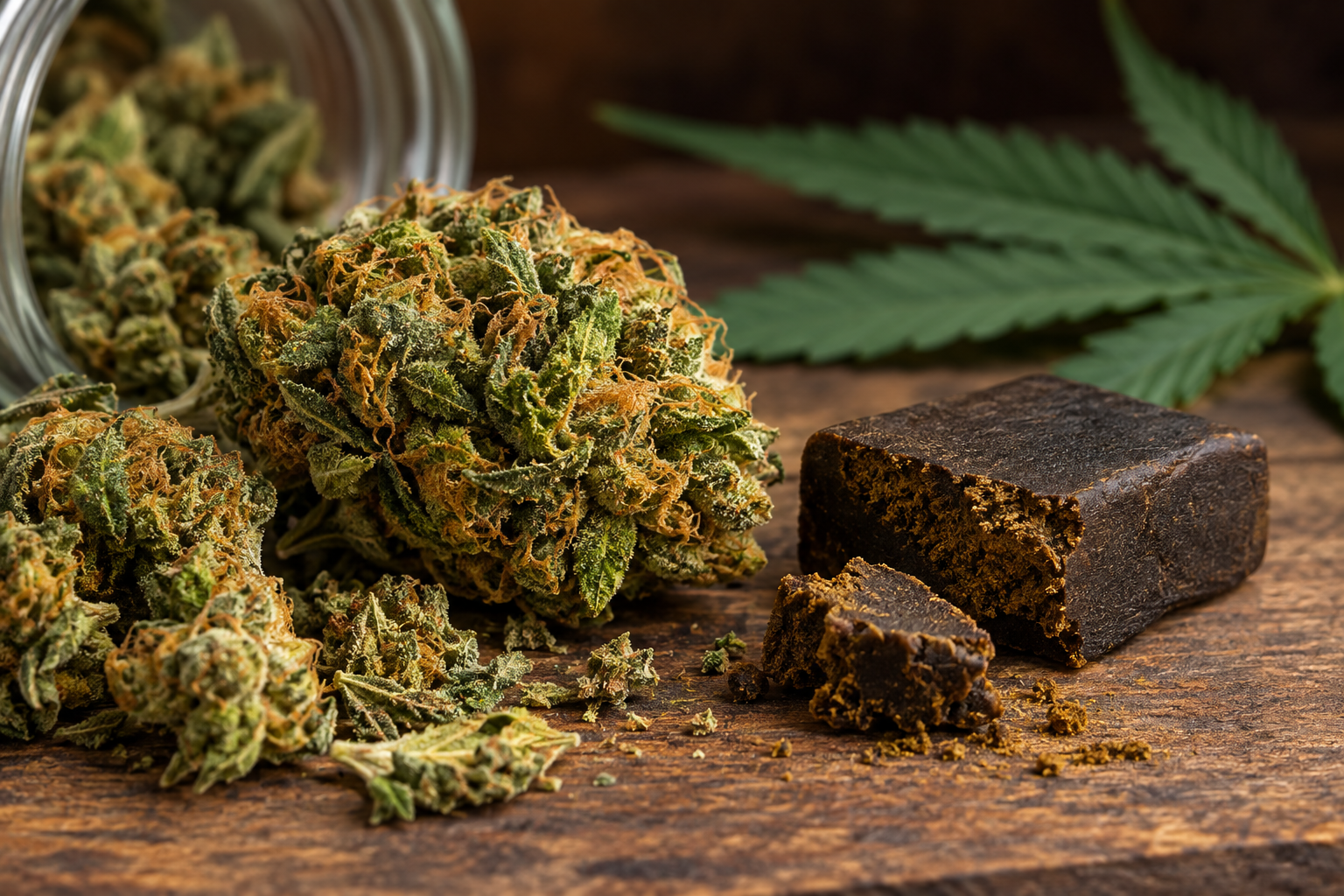
Hashish, usually called hash, is also cannabis, but it is not the same product as marijuana.
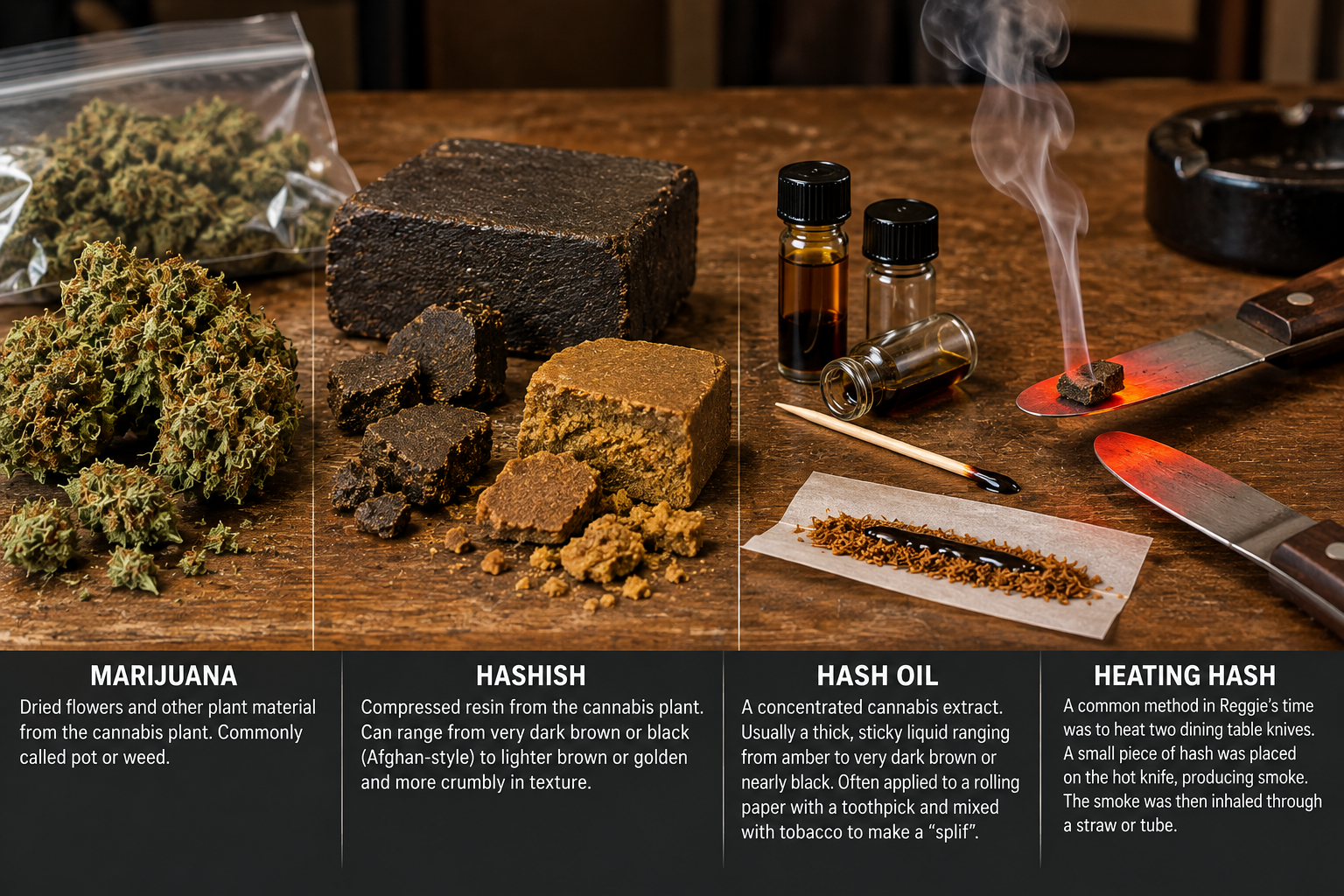
Hash is produced from the resin-rich material of the cannabis plant, which is collected and usually compressed. Traditional hash can appear as a solid block, slab, ball or smaller broken pieces. Its colour and texture vary and may range from light brown or tan to very dark brown or nearly black.
Because the plant’s resin is concentrated, hash can contain substantially more THC than ordinary dried cannabis.
Hash Oil
Hash oil is a concentrated cannabis extract rather than dried plant material or pressed resin.
Its appearance can vary, but traditional hash oil is generally a thick, sticky liquid ranging from golden or amber to dark brown or nearly black.
Because hash oil concentrates compounds extracted from cannabis, it can contain considerably more THC than dried marijuana.
How Cannabis Was Used
The cannabis products that appear in Reggie’s story were most commonly smoked, although cannabis can also be consumed orally. How a drug is taken affects how quickly its effects begin, how intense they may become and how long they can last.
Smoking Marijuana and Hash
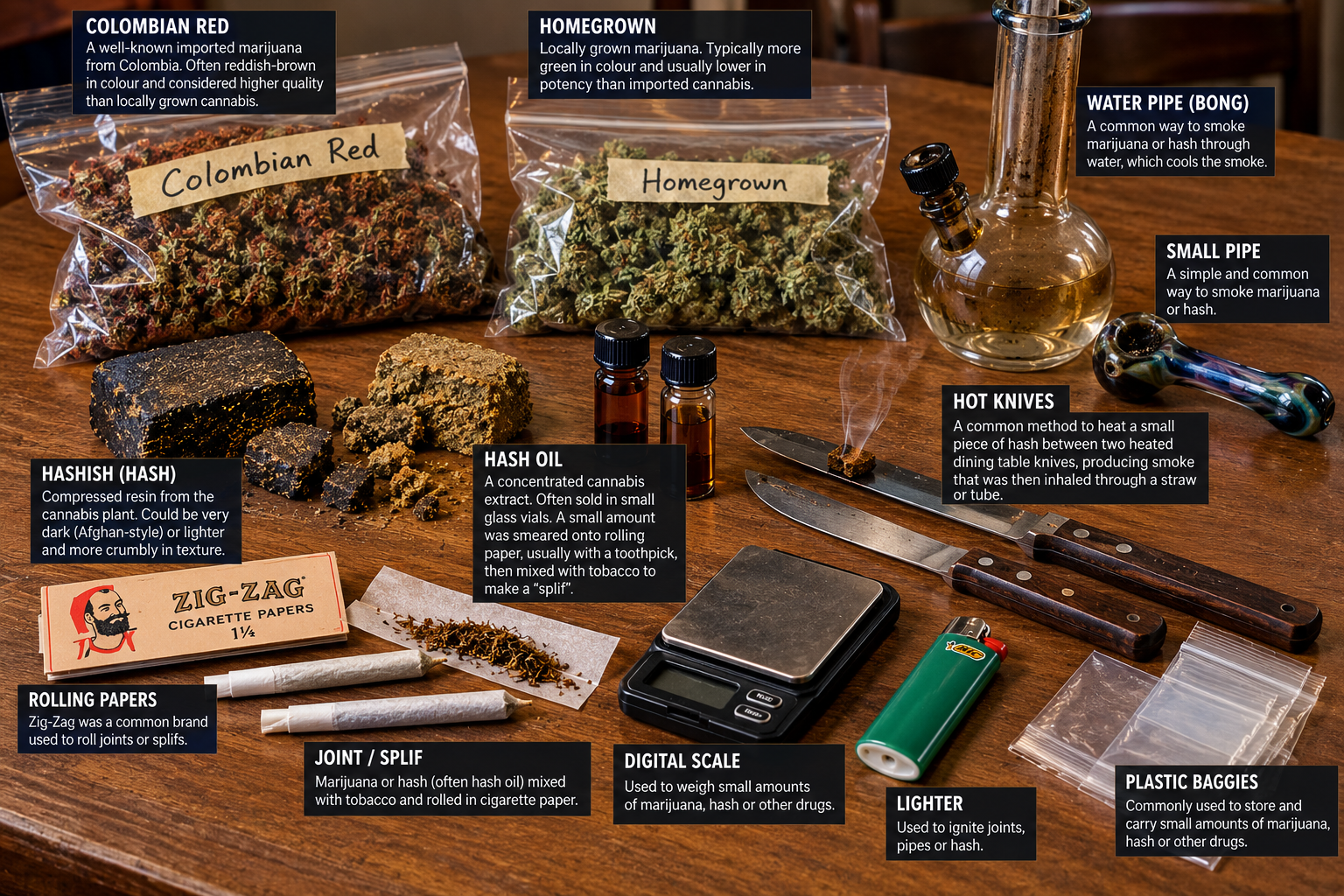
Marijuana may be rolled in cigarette paper as a joint, smoked in a pipe, or smoked using a water pipe commonly called a bong.
Items associated with cannabis use during the period covered by Reggie’s story could include rolling papers, pipes, bongs or water pipes, cigarette lighters, small containers, and objects used to cut or handle hash.
Finding one of these objects by itself does not establish that someone is using drugs. Many have ordinary uses and need to be understood in context.
Eating Cannabis
Cannabis can also be swallowed rather than smoked. When consumed orally, its effects generally take longer to begin and can last considerably longer. Because of this delay, the eventual strength of the experience can be more difficult to anticipate.
Eating cannabis appears in Reggie’s own writings and is discussed later in the account of cannabis in his life.
Effects of Cannabis
Cannabis does not affect everyone in exactly the same way. Effects can vary according to the amount consumed, the strength of the cannabis, how it is taken, the person’s age and previous experience, and whether alcohol or other drugs are also involved.
Short-term effects can include:
- euphoria or feeling “high”
- relaxation
- altered perception of time and surroundings
- sleepiness
- impaired memory and concentration
- reduced attention
- slower reaction time
- impaired coordination and judgment
- anxiety, fear or panic
Some people can also experience paranoia, disorganized thinking or, in more serious cases, a psychotic episode.
Cannabis can impair the abilities needed to drive safely, including attention, coordination and reaction time.
Potency Matters
Cannabis products can vary substantially in THC content. Higher-potency products can produce greater impairment and increase the likelihood of unpleasant or serious adverse effects.
This is particularly important when comparing products available today with the marijuana and hash described in Reggie’s writings.
Young People and Cannabis
Age is particularly relevant to Reggie’s story because his involvement with marijuana and hash began when he was very young.
Beginning cannabis use during adolescence is associated with greater risks. Frequent, long-term use can affect memory, concentration, thinking and decision-making, and early and frequent use is associated with a greater risk of developing cannabis dependence and other mental-health problems.
This does not mean that every young person who experiments with cannabis will develop an addiction or progress to other drugs. Reggie’s experience was his own. But understanding the risks associated with early drug use provides important context for the story that follows.
Part 2 — Cannabis in Reggie’s Life
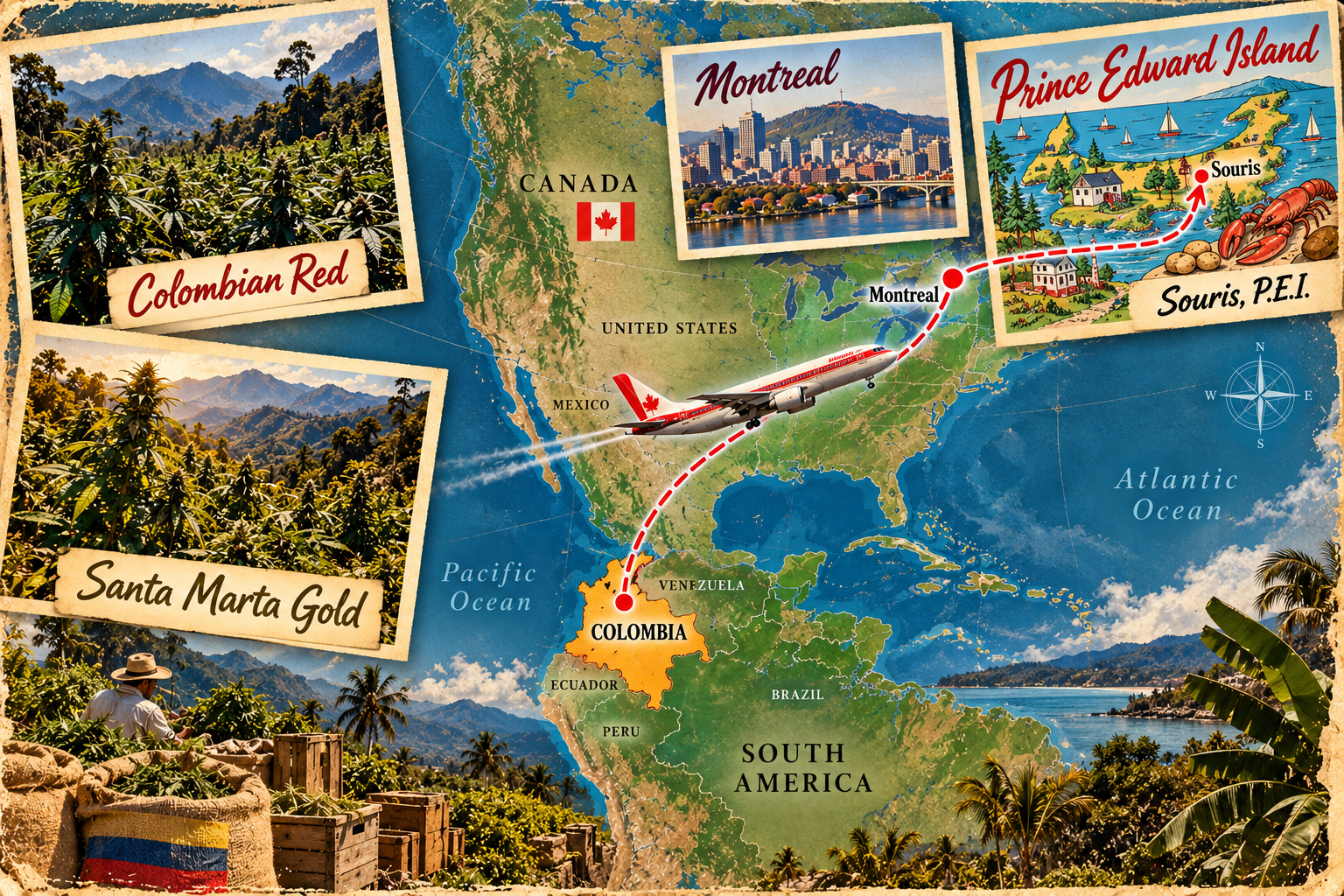
Cannabis entered Reggie’s life when he was still a child. What began with marijuana soon expanded into selling marijuana and hash, connections to suppliers outside Prince Edward Island, and eventually drug dealing during his university years.
Reggie left unusually detailed accounts of these years in My Story and The History of Me. His own writings provide the foundation for the story that follows.
Selling Marijuana at Twelve
Reggie traced the beginning of his involvement in the drug trade to an extraordinarily young age:
“So, I started selling pot. I was 12 years old.”
His Montreal cousin Mike played an important role in that introduction. During visits to Prince Edward Island, Mike exposed Reggie to marijuana and to a world that was very different from the one surrounding him in Souris.
What might initially have seemed exciting or rebellious became something much more consequential. Reggie was not simply experimenting with marijuana as a young teenager; by his own account, he had begun selling it.
The Montreal Connection
Family recollections provide additional context for Reggie’s account.
Mike was an older cousin from Montreal, and to a young Reggie his visits brought exposure to a world that seemed exciting, sophisticated and far removed from small-town Prince Edward Island. That influence extended beyond marijuana itself. Mike provided Reggie with an early connection to people, drugs and opportunities that otherwise would have been far outside his experience at that age.
Looking back, his influence appears to have been significant. Reggie would eventually develop drug connections extending well beyond Prince Edward Island, particularly through Montreal.
Read more: Reggie’s Montreal Cousin — Supplier Mike
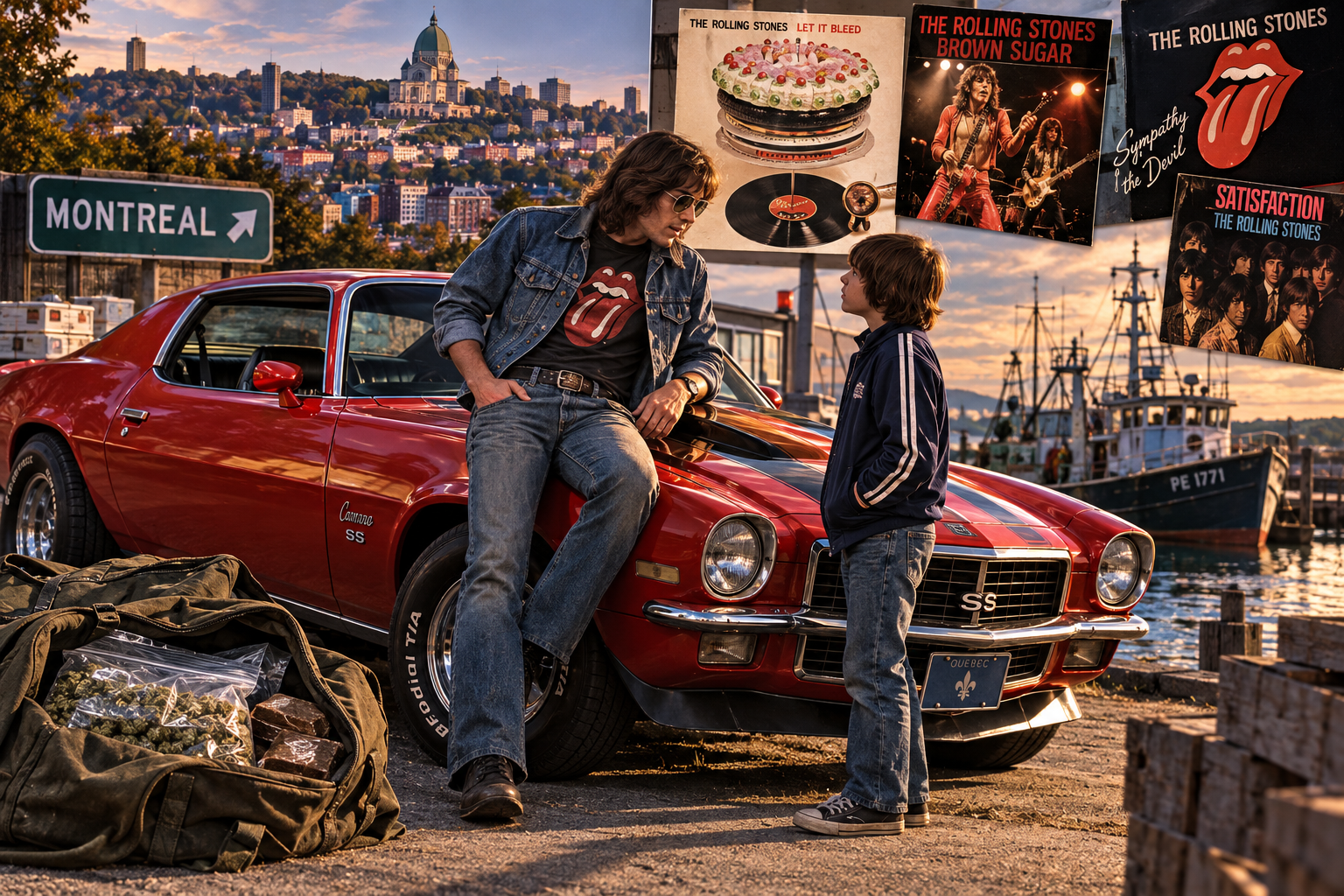
Artist’s reconstruction: Reggie’s older Montreal cousin represented a very different world to the young Reggie—muscle cars, music, money and access to drugs. Based on family recollections.
From Marijuana to Hash
Marijuana was only the beginning. As Reggie became more involved in selling drugs, hashish became increasingly important.
Hash was compact, relatively easy to conceal and widely available in the drug market Reggie encountered during the 1980s. His writings contain repeated references to different varieties and sources of hash, reflecting how much more deeply involved he had become in the drug trade.
This represented an important change. Reggie was no longer simply a twelve-year-old selling marijuana to friends. Drugs were becoming part of the way he made money, the people he associated with and the risks he was willing to take.
A Pound of Marijuana
Reggie’s timeline records another striking event the following year.
In 1981, he wrote that he and another person bought a pound of marijuana from a crew member aboard a potato boat docked in Souris.
The entry is brief, but the quantity is significant. Reggie was still in his early teens.
It also shows that his access to cannabis was no longer dependent solely on his Montreal connection. Living in a port community created other opportunities, and Reggie was already willing to take advantage of them.
Cannabis and the University Years
Cannabis—and particularly hash—continued to play a role as Reggie grew older.
During his university years in Halifax, Reggie described travelling to Montreal to obtain hash and cocaine, which he then sold at Saint Mary’s University.
By this point, what had begun with selling marijuana as a child had developed into a much more established pattern of drug dealing.
The University Drug Bust
Reggie wrote that shortly before his arrest he had purchased approximately a quarter-pound of hash.
When police searched him, they found roughly 20 grams. Reggie wrote that they failed to discover a larger piece that he had managed to move before the search.
The arrest had consequences well beyond the drugs themselves. It became part of the sequence of events that brought his university years to an end and contributed to another major change in the direction of his life.
Related story: The University Drug Bust

Using and Selling Were Not the Same Thing
One detail in Reggie’s timeline is particularly important when reconstructing his cannabis history.
For 1985, Reggie wrote that he “quit smoking hash.” Yet his timeline records that in 1986 he was arrested for selling hash.
Those statements are not necessarily contradictory. They illustrate why it is important throughout this archive to distinguish between Reggie’s drug use and his drug dealing. Stopping his own use of a particular drug did not necessarily mean that he had stopped selling it.
That distinction becomes increasingly important as his story progresses and other drugs enter his life.
Eating Cannabis
Smoking was not the only way Reggie experimented with cannabis.
He also wrote about deliberately eating cannabis to experience its effects, describing what he called a “full body stone.”
Eating drugs also appears elsewhere in his story for a very different reason: avoiding their discovery by police. In those situations, consuming the drug was not necessarily about getting high, but could be an attempt to destroy evidence.
Reggie would later describe swallowing other drugs when he believed police were about to find them. The circumstances were very different, but together these incidents illustrate the increasingly complicated relationship he developed with drugs—not simply using them, but experimenting with their effects, selling them, carrying them, and sometimes making dangerous decisions to avoid being caught with them.
Cannabis in the Larger Story
Cannabis was the first illegal drug trade Reggie described becoming involved in, but it was only the beginning of a much longer story.
His experiences with marijuana and hash introduced him at a remarkably young age to drug use, dealing, suppliers, buying and selling larger quantities, and eventually encounters with police.
Cannabis should not, however, be treated as a simple explanation for everything that followed. Reggie’s later addiction involved different drugs, different circumstances and increasingly serious consequences.
What his cannabis history does provide is an unusually early view of a pattern that would recur throughout his life: curiosity about drugs, access to them, involvement in selling them, and a willingness to take risks around both their use and their distribution.
Part 3 — Selected Stories & Writings
The stories below have been selected because they provide important additional context for understanding the role cannabis played in Reggie’s life. They are not intended to include every reference to marijuana, hash or hash oil in the archive.
My Story
Reggie’s own account
Reggie’s older Montreal cousin played an important role in his early exposure to marijuana and the drug trade. This story combines Reggie’s account with family recollections about the cousin who became one of his early drug connections.
His Montreal Cousin & Supplier
Family recollection and context
My Story is one of the principal sources used in reconstructing Reggie’s early involvement with cannabis and the drug trade. Here, readers can continue with Reggie’s account in his own words.
Read: His Montreal Cousin & Supplier
Artist’s reconstruction: Reggie’s older Montreal cousin represented a very different world to the young Reggie—muscle cars, music, money and access to drugs. Based on family recollections.
Explore More in the Archive
This page highlights selected material from the archive. Additional references may appear throughout Reggie’s writings, family recollections, documents and other stories. Use Search the Archive to explore this subject further.