
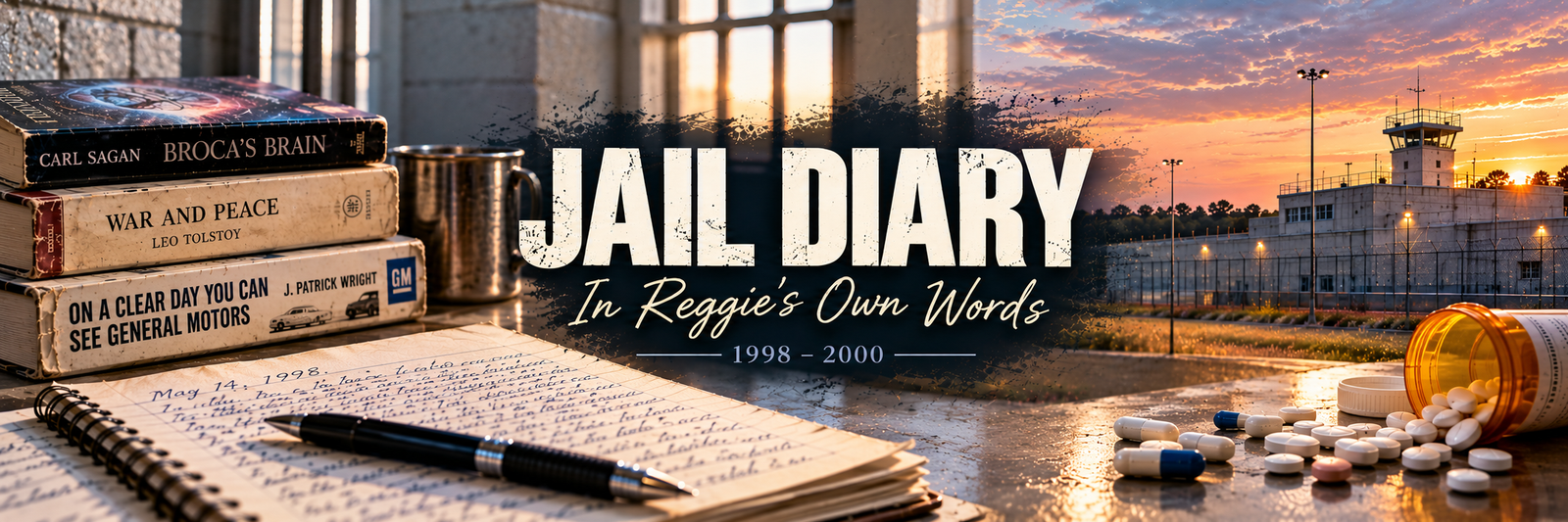
Books Reggie Read in Jail
Reading became an important part of Reggie’s life in jail.
His Jail Diary is filled with references to books and newspapers. He read novels and nonfiction, tried to learn new languages, read French-language newspapers when he could get them, and sometimes spent a surprising amount of effort simply trying to find something worth reading.
On October 24, 1999, after spending most of the day reading newspapers, Reggie found the perfect description for himself:
“I spent the whole day reading newspapers and I enjoyed it. I’m an information junkie.”
Something to Read
In jail, something as ordinary as a newspaper could become important.
The previous day, Reggie had written:
“I hope that [Guard 3] will bring in a paper tomorrow so I’ll have something to read. Sunday is always such a long boring day here.”
The guard apparently did, and Reggie spent much of the following day reading.
When newspapers were scarce, he could become equally frustrated when another inmate monopolized one. Outside jail that might seem trivial. Inside, where Reggie had little control over how he spent his time, it mattered. Pasted markdown
Access to reading material also became one of the institutional issues Reggie challenged. He complained about restrictions on books and educational material and even raised some of his concerns with government officials and the press. Pasted markdown
For Reggie, reading wasn’t simply entertainment. It occupied his mind and gave him access to a world beyond the institution.
What Reggie Read
The Jail Diary records a surprisingly varied collection of books:
War and Peace — Leo Tolstoy
Reggie admitted that he was getting “bogged down” trying to keep track of the characters—with about 700 pages still to go.
Broca’s Brain — Carl Sagan
A collection of writing about science, skepticism and human understanding.
Shōgun — James Clavell
Another substantial novel Reggie tackled while incarcerated.
On a Clear Day You Can See General Motors — J. Patrick Wright
A nonfiction account involving automobile executive John Z. DeLorean and General Motors.
City of Joy
The Pope of Greenwich Village
Disturb Not the Dream
Black Light — Elizabeth Hand
Reggie’s review when he finished it was brief: “not bad”
Other books appear in the diary but have not yet been positively identified. Rather than guess at titles or authors, they can be added as the original entries are reviewed. Pasted markdown
Learning Languages
Reggie’s curiosity went beyond books.
At different points he obtained material to study Spanish, Polish, Japanese and French. He also sought out French-language newspapers. Pasted markdown
There didn’t necessarily have to be a practical purpose or a certificate at the end. Sometimes Reggie simply wanted to learn something he didn’t already know.
Making a Small World Larger
Reggie watched television too. He could become genuinely excited when something interested him—on one occasion an episode of Behind the Music about Ozzy Osbourne “made my day.” What irritated him was the repetition and mindlessness of institutional life. Pasted markdown
Jail had made Reggie’s immediate world very small.
A newspaper could improve his day. A book could occupy him for weeks. A language could give him something new to learn.
Much of the Jail Diary concerns drugs, court appearances, institutional rules, parole, treatment, anger and boredom. But his reading runs quietly alongside all of it.
He was reading Tolstoy and Carl Sagan. He was learning languages. He was looking for French newspapers. He was arguing about access to books. And sometimes he was simply annoyed because somebody else wouldn’t hurry up and finish the newspaper.
Together, those details reveal another side of Reggie.
He described it best himself:
“I’m an information junkie.” Pasted markdown