
His Belief That He “Wouldn’t Get Caught”
Reggie’s involvement with drugs appears to have begun around the time he entered high school—Grades 9 through 12 in Souris. He started selling marijuana and hashish, the compressed resin of the cannabis plant.
My next-younger brother and I tried at various times to convince Reggie to stop what he was doing, but he was strong-willed and determined to follow his own path. He also seemed convinced that he was smarter than the local police.
I have a lot of sympathy for parents who find themselves in similar situations. A teenager may not yet have the experience to understand where his actions could eventually lead, while at the same time being resistant to authority and completely convinced of his own point of view.
Years later, many families contacted my father looking for advice about problems with their own children. Most of those calls concerned addiction, but I think many shared the same underlying frustration: What do you do when someone you love refuses to listen?
Looking back, although I knew Reggie was involved with marijuana, I had no idea that he would begin committing more traditional crimes—breaking into buildings, stealing alcohol and, later, breaking into cars and stealing stereos.
His First Major Crime, a Booze Burglary
One morning, probably in the fall of 1980, I was looking for something in my grandfather’s barn when I moved a few things around and discovered a full case of Johnnie Walker Scotch hidden there.
I had no idea why a case of Scotch would be hidden in the barn. I left the case where it was—but helped myself to one bottle.
A couple of days later, I believe Reggie told me that the Scotch was his. He and someone else had found an open window at the Knights of Columbus Hall down the street, climbed through it, and stolen the Scotch along with other liquor.
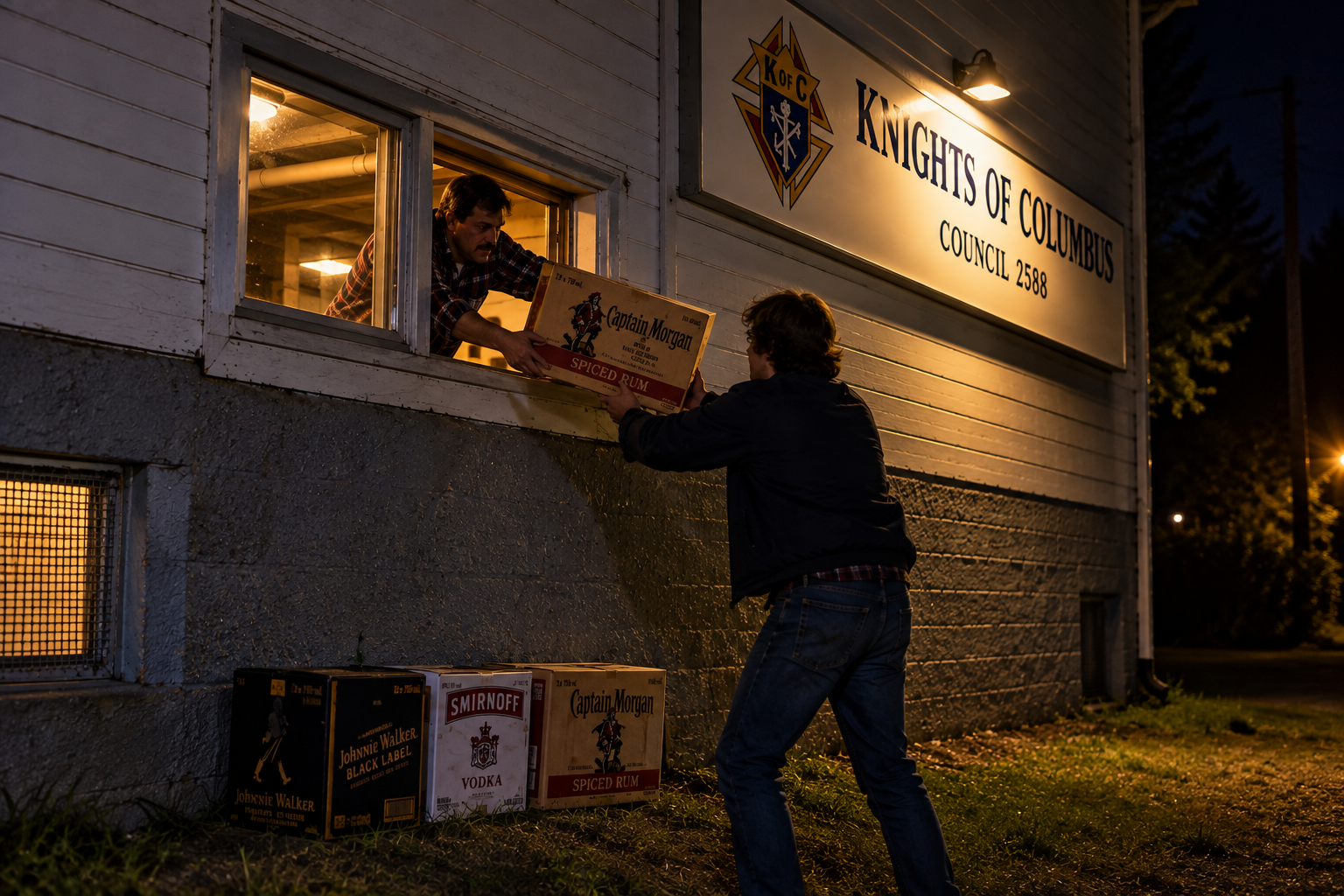
I don’t remember how the RCMP discovered that Reggie was involved, but they did. He was charged and appeared in Juvenile Court a couple of months later.
Mum and Dad went to court to support him. Dad spoke on Reggie’s behalf and emphasized that Reggie would not be doing anything like this again.
The judge apparently agreed that the boys should be given another chance. The other participant was ordered to pay restitution of something like $500. But when Reggie’s sentence was read, somehow no restitution had been ordered for him.
What disturbed me most afterward was Reggie’s reaction. Rather than seeming chastened by the experience, he gloated about the fact that the judge had forgotten to make him pay the damages his partner had been ordered to pay.
Looking back, I sometimes wonder whether the relatively mild consequences—and the lack of serious punishment at home—sent Reggie the wrong message. I cannot know what lesson he actually took from the experience, but it clearly did not end his willingness to take risks.
Breaking Into the Molson Beer Truck
A pattern seemed to be developing. Reggie and his friends wanted alcohol, and they were becoming increasingly willing to steal it.
The bank robber Willie Sutton is famously associated with the explanation that he robbed banks because “that’s where the money is.” Reggie and his friends wanted beer, and they knew where the beer was.
The Magdalen Islands ferry terminal was only a short walk from our house. During the winter, when the ferry operated on a more limited schedule, transport trucks could sometimes sit in the terminal parking lot while waiting for the next crossing.
One of those trucks was carrying Molson beer.

Reggie and a couple of his friends broke into the trailer and stole several cases.
What I remember most clearly is Dad’s reaction. He explained that the value of the stolen beer wasn’t really the biggest problem. The trailer had been sealed after loading to indicate that the shipment had not been opened or tampered with while in transit.
Reggie and his friends had broken that seal.
To Dad, that made what they had done considerably more serious than simply stealing a few cases of beer.
He Got Caught Again
I no longer remember how the police determined that Reggie was involved, but they did.
This was another juvenile offence. I don’t remember the details of what happened in court, although my recollection is that Reggie received probation rather than any substantial period of custody.
What matters more to me, looking back, is that Reggie had now been caught at least twice.
He was an intelligent kid and seemed convinced during these years that he was smarter than the local police. Yet his own experience was already telling him something different.
He could get caught.
And he did.
Reggie believed that offences committed as a juvenile would essentially be behind him once he became an adult. Whether or not his understanding of the juvenile justice system was correct, that appears to have been how he viewed it.
I sometimes wonder whether he took the wrong lesson from these early encounters with the justice system.
Instead of concluding, “I’m going to get caught if I keep doing this,” perhaps the lesson he took was, “Even when I get caught, not much happens to me.”
We cannot know whether that was actually how Reggie reasoned at the time. What we do know is that his behaviour did not stop.
Once he entered the adult justice system, however, being caught would carry much more serious consequences.